

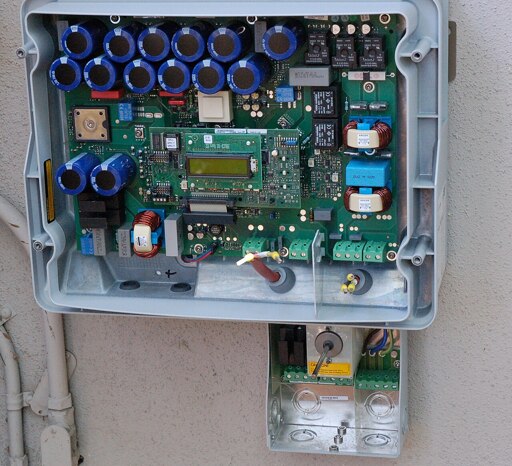
They’re ridiculously expensive and not very efficient compared to DC systems.
One disadvantage is that they are less efficient when combined with a battery than a single hybrid inverter.
Converting DC to AC and then back to DC to charge your batteries causes a bigger loss compared to the DC-DC voltage conversion needed for a hybrid inverter.
For those that don’t want to click the link herea the important part of what they are: The main advantage is that they electrically isolate the panels from one another, so small amounts of shading, debris or snow lines on any one solar module, or even a complete module failure, do not disproportionately reduce the output of the entire array. Each microinverter harvests optimum power by performing maximum power point tracking (MPPT) for its connected module.[14] Simplicity in system design, installation, lower wire amperage, simplified stock management, and added fire safety are other possible benefits.
The primary disadvantages of a microinverter include a higher initial equipment cost per peak watt than the equivalent power of a central inverter since each inverter needs to be installed adjacent to a panel (usually on a roof). This also makes them harder to maintain and more costly to remove and replace. Some manufacturers have addressed these issues with panels with built-in microinverters.[15] A microinverter often has a longer lifespan than a central inverter, which will need replacement during the lifespan of the solar panels. Therefore, the financial disadvantage at first may become an advantage in the long term.
The lower wire amperage, and fire safety where my major reasons for choosing such a system. DC and high power is dangerous when compared to similar power in AC systems.
I’m also one of those people that like to see what the individual panel is doing and logging the data
Smart, I think a lot of people though still don’t really know about this setup. I only learned about the benefits yesterday. It really pays to dig a bit deeper, especially for someone making a big decision to invest and install solar.
I’ve had a micro inverter solar setup on my roof for a few years now.
Super happy with it.
Yes, the initial outlay is more expensive, but not by much. The other thing your missing is the noise. Some large inverters make noise apparently, the micro ones do not. This was one of the main draw cards that pushed me to go this way.
Do you have batteries?
There are also MOSFET based bypass panels that can achieve a similar effect at a far cheaper price point. Quite common here in Aus.
The high voltage DC strings are dangerous, but very price + power efficient and our install and wiring rules have made it quite safe.
Yeah micro inverters are pretty useful for the vast majority of installs. Most people don’t know that if one panel of a regular install gets shaded your entire string loses output, not just that single panel.
Great explanation. Thanks!
Do they make any without telemetry/connectivity?
More than likely they do. All the inverters do on solar panels is isolate each panel individually. Because of how they’re wired up, normally a panel getting a little bit of shade can affect multiple panels if they’re wired up in sequence so with these if one panel gets some shade the others will continue working at their maximum potential. There shouldn’t really be a need for telemetry
The biggest advantage is knowing the status of each panel, which is what makes it outweigh the additional initial cost. So yea, you could do them without telemetry, but then the question would be why not just get a string inverter at that point?
Yeah but you can’t do anything about it so what’s the point? It sounds to me like they are selling pretty graphs.
I don’t understand. I thought they got higher output? Is that not the advantage? Why would I want a solar panel that talks to the internet? That sounds horrible.
Networked panels are useful in several ways. First is that they let you track power generation, which is useful to know what return youre getting on your investment. It also helps you understand where to add or move panels for maximum output.
Second is that they can send data to batteries in order to charge them more efficiently in the case of weather events. Your controller sees a storm is coming tomarrow? Maybe it focuses on topping up batteries to 100% so you have max coverage in an outage.
Third is that you can sometimes participate in virtual power plants where you automatically sell you battery capacity to the grid with thousands of others as a way to prevent fossil fuel plants spinning up during peak demand. These programs can net thousands/year in income for solar owners if your power company supports them.
My solar application was folding panels out above a livable electric car/van to escape rent. I don’t think this is applicable to me. I always want to fill up the battery and getting the most out of the panels seems like it’s more a function of where I’d park.
And a fourth is, if you have a dynamic energy contract, where prices can change as quick as every 5 minutes, your energy provider can stop your panels from delivering power to the grid when prices are negative. otherwise you’d pay for every watt delivered back.
You can do this manually (as in diy, you can automate it with eg home assistant of course) with modbus on a lot of inverters, but idk how that works with these micro-inverters.
Why are power companies giving away free energy?
That’s how supply and demand works.
Energy suppliers have to buy their energy from the actual sources, of which there are a few here. They buy all the watts they think they’ll need based on a weather forecast the day before. If this forecast was rainy but now turns out to be super sunny, meaning lots of solar which can support the grid, there may be massive excesses of energy that now no one wants to buy. But due to the way an electricity grid works, this electricity has to go somewhere, so they sell it at a loss.
That’s how it works in the Netherlands, anyway.
There are a few where alternative firmware has been created that removes the cloud tether and gives better integration with Home Assistant. Some also have Bluetooth
Some can be controlled through a local API, but often you still need a gateway to facilitate access (it can reach out to the cloud, but it can be disabled and used local only).
Some that were in very good standing (Hoymiles) recently had security flaws where the manufacturer refuses to acknowledge or fix them, leading to essentially anyone to control them at any time with a few dollars worth of equipment (source in German). They basically broadcast their own encryption key.
Unfortunately the nature of getting a distributed system makes them much more vulnerable to issues like that as some form of communication is needed for everyday operation. This is much simpler with a central system.

